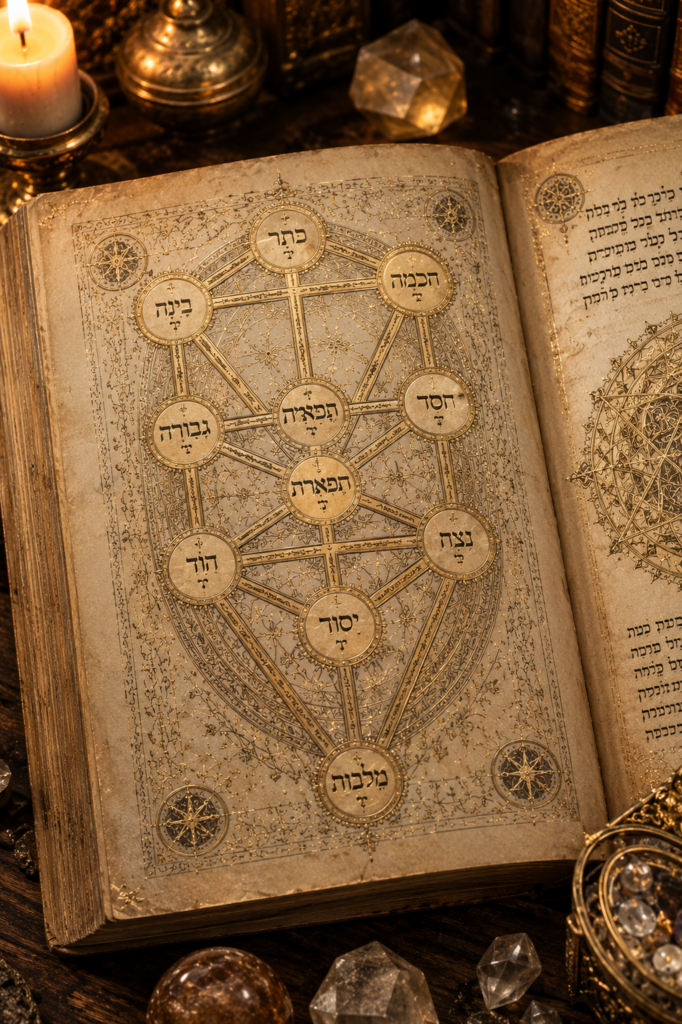
Gimel connects the highest point of the Tree — Keter, the crown, the source — directly to Tiferet, the heart center. This is the path of grace: not grace as a religious concept, but grace as the experience of something arriving from a level beyond the ordinary self and landing in the integrated center of who you are. The energy flows both ways — a channel through which the deepest will becomes alive in the heart, and through which the heart, at its most fully open, reaches toward its source.
The Hebrew letter Gimel traditionally represents the image of walking, of movement — a figure in motion. This path does not sit still. Grace is not passive reception. It requires a kind of active opening, an orientation toward something beyond what the rational mind can reach, combined with the willingness to be changed by what arrives.
In lived experience, Gimel manifests as the moments when you are acting fully from your deepest values without effort or self-consciousness: the conversation in which you forget yourself and are simply present; the creative work that arrives without struggle; the decision made from the core of who you are.
**In daily life:** Gimel is active when you are moving through the world from your center rather than from your history or fear. When a solution arrives that you did not construct consciously but that is completely right. It is absent when the gap between what you know at the deepest level and what you actually do is large and persistent.
**Practice:** Sit quietly. Ask: what would my life look like if I acted from the deepest thing I actually know? Not your aspirational self. The deepest steady knowing that is already in you. Notice where there is alignment between that knowing and your actions — and where there is a gap. The gap is where Gimel needs to flow.
**Pitfall:** When the path of Gimel is sought rather than received, it produces spiritual inflation: the person who believes they are acting from grace but is actually acting from the need to feel special or beyond ordinary accountability. True grace makes a person more human, more humble, more responsive to others — not less.