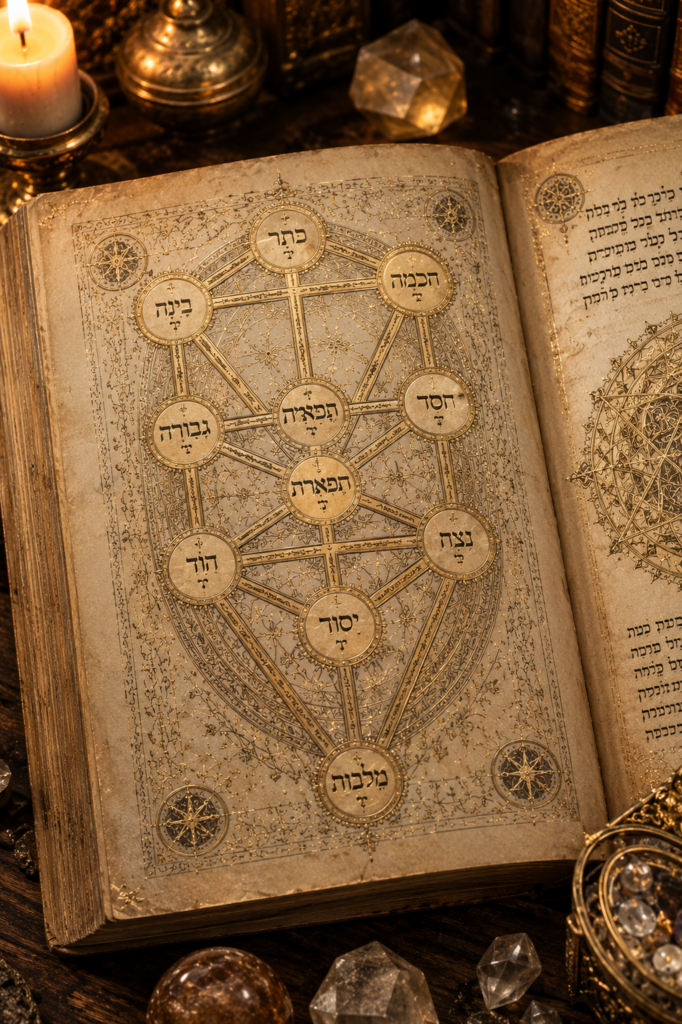
Tet means serpent. The path it travels on the Tree — horizontally between Chesed and Gevurah, between loving expansion and precise contraction — is the path of active transformation. Not the gradual transformation of time passing, but the specific transformation that happens when two opposing forces are held in the same space and their tension is allowed to work rather than resolved prematurely.
The serpent image carries its full complexity here. In Hebrew tradition, the serpent is associated with wisdom — the oldest knowledge, the one that coils around itself and contains its own completion. The serpent also sheds its skin: it transforms from within, leaving behind what is no longer its form. This is the quality of Tet: transformation that is not escape from the old self but a renewal of the self from within — shedding rather than running.
The path between Chesed and Gevurah is one of the most charged on the Tree. These two forces — pure generosity and precise judgment — are natural opposites. Tet is the capacity to hold the tension between them: to be both generous and precise at the same moment, and to let the friction between those two states generate something new.
**In daily life:** Tet is working when a confrontation you were dreading results in something genuinely new rather than just pain. When you hold the tension between wanting to give and needing to set a limit, and the result is a more honest relationship. It is absent when all tension is immediately relieved through distraction or false resolution.
**Practice:** Identify a tension you have been trying to resolve that keeps returning. Ask: what if this tension is not a problem to resolve but a process to be lived? What would change if you allowed the friction between these two things to continue a little longer, without forcing a conclusion?
**Pitfall:** When Tet is misused, the love of transformation becomes addiction to crisis. The person who needs tension, conflict, or upheaval to feel alive. Who confuses disruption with growth and mistakes drama for depth.