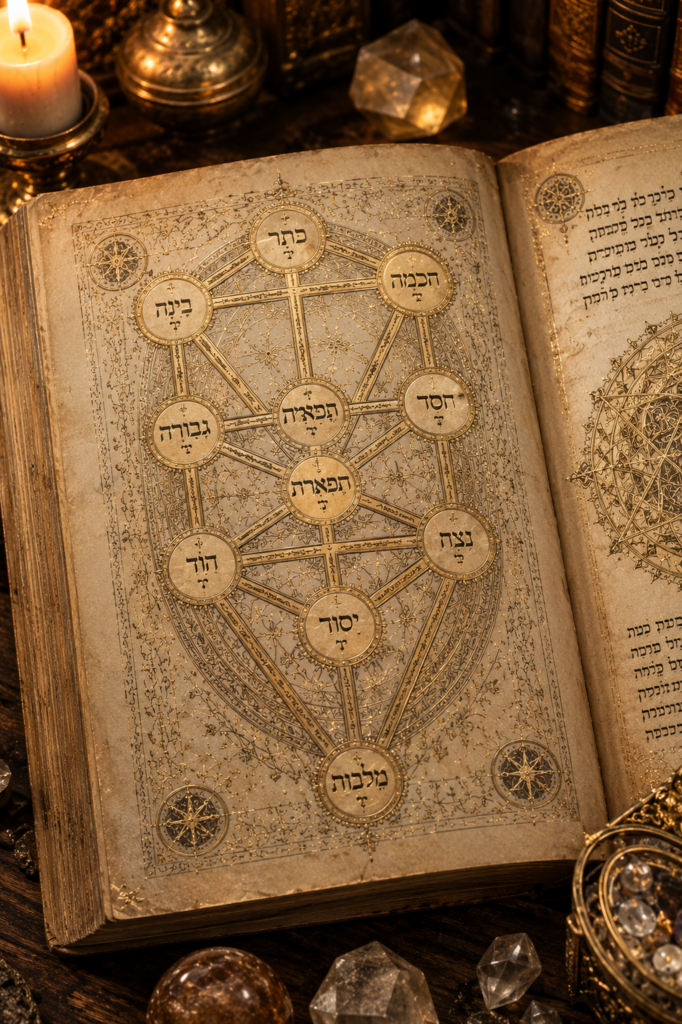
Heh means window. The connection it makes — from Chokhmah, the flash of pure wisdom, down and across to Tiferet, the integrated heart center — is the path of illuminated seeing. Not looking, but seeing. The window is the image precisely because a window lets light through without generating it: it does not create the view, it makes the view accessible.
This is the path of perception that has been clarified by wisdom. When Chokhmah’s flash of pure insight reaches Tiferet’s centered balance, the result is a quality of seeing that is both penetrating and warm — the ability to perceive what is true about a person or situation without the distortion of projection, need, or the desire to find something specific. The window is clean glass: it does not add color to what passes through it.
In the Kabbalistic tradition, Heh appears twice in the Tetragrammaton, the central divine name. Its repetition suggests that this seeing — this quality of window-like transparency — is not a singular mystical event but a recurring quality of consciousness, available at multiple levels of experience.
**In daily life:** Heh is working when you see a situation as it actually is rather than as you hoped or feared it would be. When you notice something about a person that you had been unable to see because you needed them to be different. It is absent when perception is consistently shaped by what you need to find.
**Practice:** In your next significant interaction, notice the first moment when you become certain you know what they mean. Pause. Ask: is this what they actually said, or is this my translation? Most of the time there is a gap. The moment you notice the gap — the space between what arrived and what you interpreted — you are practicing Heh.
**Pitfall:** When this path is overactive, it becomes the illusion of objectivity: the belief that one is perceiving clearly when one is actually perceiving through a very clean-looking but still distorting lens. True seeing includes the awareness of one’s own position as the seer.